Refractive index of liquid using concave mirror Simulator
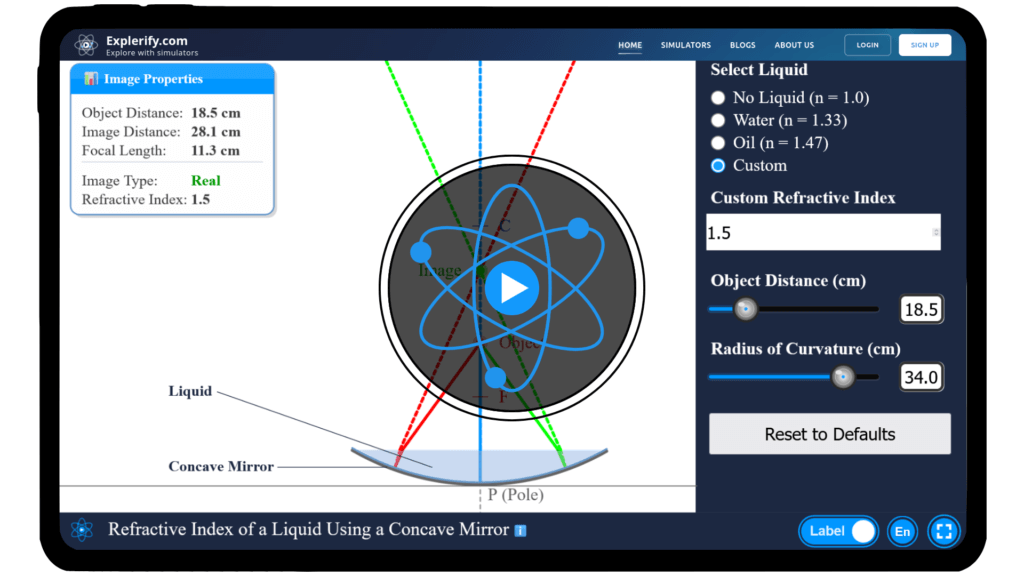
Explore how liquids bend light using our concave mirror simulator. Adjust object distance, mirror curvature, and liquid type to observe how focal length, image position, and ray paths change in real time.
Physics shapes the world around us—often in subtle ways we rarely notice. For example, have you ever observed how objects appear distorted when viewed through water, oil, or any transparent liquid? This simple everyday effect is a doorway into a deeper concept: refractive index—a measure of how light bends when passing from one medium to another.
With our interactive simulator, you can explore this phenomenon firsthand. Place an object in front of a concave mirror, fill it with different liquids, and observe how the image shifts, sharpens, or becomes virtual—all depending on the refractive index. Adjust variables like radius of curvature, medium type, and object distance to uncover how light behaves when transitioning between air and liquid.
Begin your exploration into the hidden world of optics and discover how liquids transform reflection, focus, and image formation—experiment with refractive index using a concave mirror today!
\( \mu = \frac{R}{R’} \)
Mathematical description
where:
\( n \) is the refractive index of the liquid
\( R \) is the real radius of curvature of the concave mirror (without liquid)
\( R’ \) is the apparent radius of curvature of the mirror when the liquid is present
Simulator
Discover how different liquids affect image formation with our refractive index simulator!
Interactive Physics Simulator – Image Formation by Concave Mirror
Share with your friends
Explore Liquid Refractive Index using Mirror
One Question at a time!
Qus 1. What is the purpose of this simulator?
This simulator helps users determine the refractive index of a liquid by observing how the presence of the liquid changes the focal length of a concave mirror. By comparing the real and apparent radii of curvature, users can calculate the refractive index using a mathematical relationship.
Qus 2. What principle is this experiment based on?
This experiment is based on the principle of reflection of light and optical path modification. When a liquid is introduced between the mirror and the measuring instrument, the optical distance changes, resulting in a shifted focal point. This shift helps determine the refractive index of the liquid.
Qus 3. Why does the radius of curvature appear different when liquid is added?
The liquid creates an additional medium with a different refractive index, altering how light rays converge after reflecting from the mirror. This change makes the mirror appear to have a different radius of curvature, even though its physical curvature remains unchanged.
Qus 4. What are real-world applications of this experiment?
This method is used in:
Optical research to study material properties
Chemical analysis for purity testing of liquids
Food and beverage industry (e.g., oil quality or sugar concentration)
Educational laboratories to teach optical properties and refractive index concepts