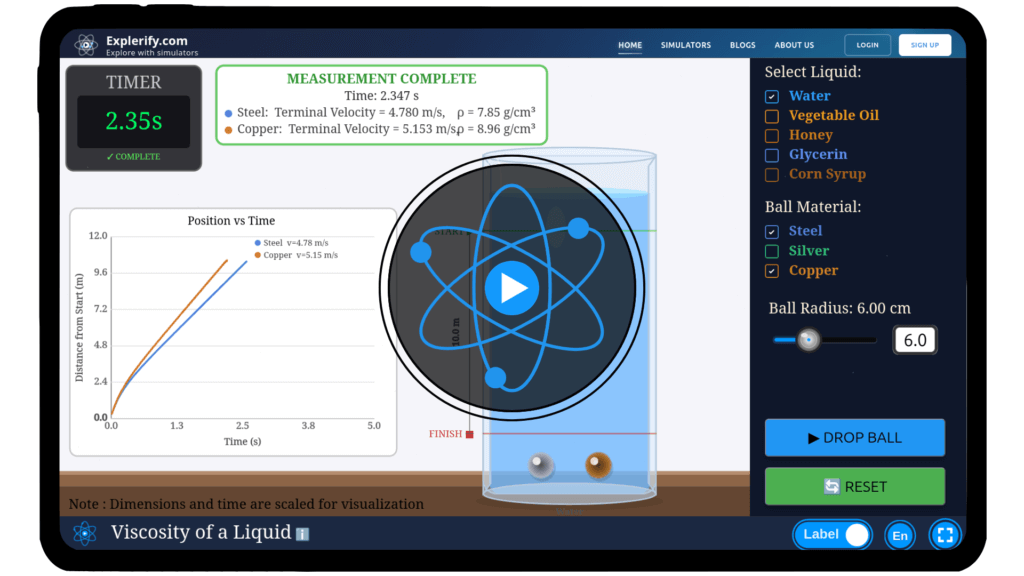
Investigate the viscosity of liquids by observing the motion of a falling ball and experiment with different liquids, ball sizes, and materials to study terminal velocity using our interactive simulator.
Physics surrounds us, shaping many everyday phenomena, often without us realizing it. Have you ever wondered why honey flows more slowly than water, or how fluids resist motion? This behavior is governed by a fundamental property called viscosity. With our interactive simulator, you can explore the viscosity of liquids by observing the motion of a ball falling through different fluids. Adjust variables such as liquid type, ball size, and material, measure terminal velocity, and uncover how viscosity influences fluid motion. Step into the world of fluid physics and experiment with the viscosity of liquids today!
Dive into the physics of fluid motion with our interactive viscosity of a liquid simulator!
Interactive Physics Simulator – Image Formation by Concave Mirror
Share with your friends
FAQs
Qus 1.What is viscosity?
Viscosity is the measure of a liquid’s resistance to flow. Liquids with high viscosity (like honey) flow slowly, while low-viscosity liquids (like water) flow easily.
Qus 2. Why does a ball fall slowly in some liquids?
The liquid exerts a viscous drag force on the ball that opposes its motion. Higher viscosity produces greater resistance, slowing the ball.
Qus 3. What is terminal velocity in a liquid?
Terminal velocity is the constant maximum speed attained by an object falling through a liquid when gravitational, buoyant, and drag forces balance.
Qus 4. Why does the ball eventually move at constant speed?
As the ball accelerates, the drag force increases. When drag plus buoyancy equals the gravitational force, acceleration becomes zero, resulting in constant velocity.
Qus 5. What principle is used to measure viscosity in this experiment?
The experiment is based on Stokes’ law, which relates viscous drag force to velocity for laminar flow around a spherical object.
Qus 6. How does ball size affect terminal velocity?
Larger balls experience greater gravitational force. In laminar flow, terminal velocity increases with the square of the radius of the ball.
Qus 7. What happens if the flow becomes turbulent?
At high speeds or for large objects, drag becomes proportional to the square of velocity. In this case, terminal velocity increases with the square root of radius.
Qus 8. Why does honey flow more slowly than water?
Honey has much higher viscosity due to stronger intermolecular interactions compared to water.
Qus 9. Does temperature affect viscosity?
Yes. For liquids, viscosity generally decreases with increasing temperature because molecular motion increases.
Qus 10. Where is viscosity important in real life?