Atom Interferometer Simulator
Step into the world of quantum sensing. Manipulate atomic wave packets, control phase shifts (in the simulator, you can control phase shifts. In the experiment, you may observe and measure them but we have limited control over them), and watch interference patterns emerge as atoms manifest their wave nature.
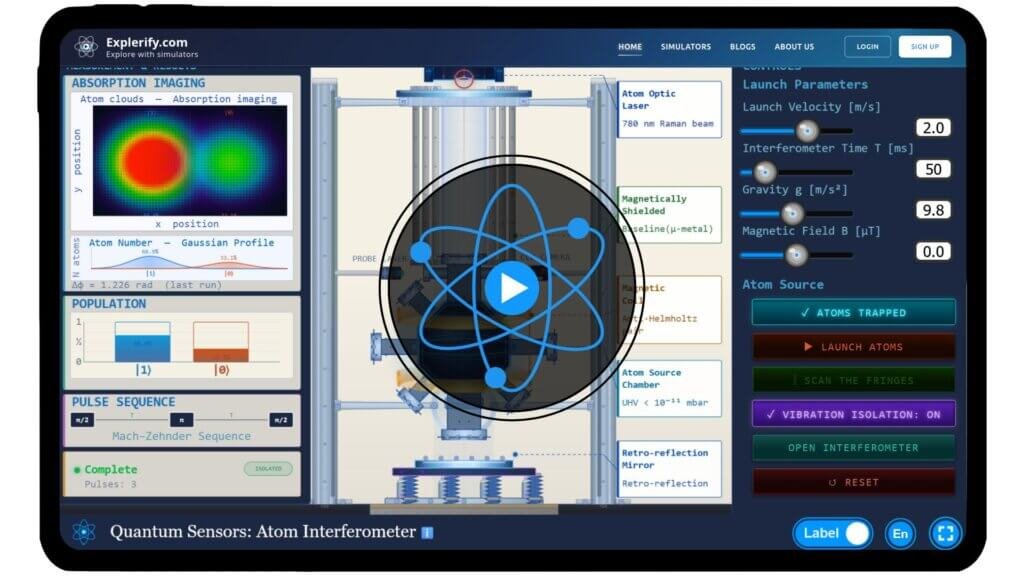
Atom Interferometer
Physics is all around us, shaping how we understand motion, gravity, and the very nature of matter. But did you know that atoms can act like waves, forming patterns through interference just like light? In an atom interferometer, this quantum phenomenon lets us detect tiny changes in acceleration and gravitational fields with astonishing precision.
Now, you can dive into this quantum world yourself with our interactive simulator. Play with key settings, watch matter waves split and recombine, and see interference patterns come to life. Discover the principles behind one of modern physics’ most powerful tools — and start exploring the cutting-edge science of atom interferometry today!
\(\Delta \phi = k_\text{eff} \, g \, T^2 \)
Mathematical description
where:
- \( k_\text{eff} \) = effective wavevector of the laser pulses (momentum kick to the atom)
- \( g \) = acceleration due to gravity
- \( T \) = time between laser pulses
FAQs on Atom Interferometer
Qus 1. What is an atom interferometer?
An atom interferometer is a device that splits atomic wave packets, lets them travel along different paths, and then recombines them. The resulting interference pattern depends on phase differences, which can reveal tiny changes in motion, acceleration, or gravitational fields.
Qus 2. How does this simulator work?
The simulator lets you split and recombine atomic wave packets virtually. You can adjust parameters like phase shifts, acceleration, and laser pulses to see how matter-wave interference patterns change in real time.
Qus 3. Why do atoms produce interference patterns?
Atoms, like light, exhibit wave-like behavior. When their wave packets overlap after traveling along different paths, constructive and destructive interference creates patterns. The phase differences encode information about forces or accelerations the atoms experienced.
Qus 4. Can I measure gravity or acceleration with this simulator?
Yes! By adjusting the simulated acceleration or phase shifts, you can see how interference fringes change. This mimics how real atom interferometers measure gravity, rotation, or other forces with extreme precision.
Qus 5. How can atom interferometers be used for precision measurements of gravity?
Atom interferometers measure gravity by detecting tiny phase shifts in interfering matter waves. As atoms fall under gravity, their paths change slightly, creating a measurable interference pattern. This allows extremely precise determination of gravitational acceleration and even small variations in gravitational fields.
Qus 6. Can atom interferometers help with navigation without GPS?
Yes! Atom interferometers act as highly sensitive inertial sensors. By measuring acceleration and rotation, they can track position over time without relying on external signals like GPS. This makes them useful for navigation in submarines, spacecraft, or areas where GPS is unavailable.
Qus 7.How do atom interferometers test fundamental physics principles like general relativity?
Atom interferometers can measure how gravity affects matter waves with very high precision. By comparing experimental results with theoretical predictions, scientists can test principles such as the equivalence principle and effects predicted by general relativity, helping refine our understanding of fundamental physics.
Qus 8. What role do atom interferometers play in geophysics and mineral exploration?
Atom interferometers can detect tiny changes in gravitational fields caused by underground structures. These variations help identify features like mineral deposits, water reservoirs, or geological formations, making them powerful tools for geophysical surveys and exploration.
Qus 9.Will atom interferometers be used in space missions?
Yes! Atom interferometers are being developed for use in space to measure gravitational fields, detect gravitational waves, and test fundamental physics in microgravity environments. They could play a key role in future space exploration and satellite technologies.
Qus 10.Can atom interferometers improve our understanding of the universe?
Atom interferometers may help answer deep questions in physics, such as the nature of dark energy, dark matter, and gravity. Their extreme sensitivity makes them powerful tools for probing phenomena that are difficult to detect with traditional instruments.
Qus 11. Will quantum sensors like atom interferometers become widely used?
As technology advances, atom interferometers could become more compact and affordable. This may lead to their use in everyday applications like navigation systems, environmental monitoring, and even smartphones in the distant future.
Qus 12. Could atom interferometers help detect gravitational waves?
Yes, next-generation atom interferometers are being explored as detectors for low-frequency gravitational waves. These could complement existing observatories and open new windows into cosmic events like black hole mergers.
Qus 13. What challenges must be overcome for widespread use?
Current systems are complex and require precise control of lasers and ultra-cold atoms. Future research aims to make them smaller, more robust, and easier to operate, enabling real-world deployment outside laboratories.
Qus 14. How could atom interferometers shape the future of navigation?
In the future, atom interferometers could enable fully autonomous navigation systems that don’t rely on GPS. This would be especially valuable for deep-sea exploration, space missions, and defense applications where external signals are unavailable or unreliable.