Microgravity Simulator
Explore microgravity through a falling capsule experiment and observe how objects inside experience weightlessness when all parts accelerate equally under gravity.
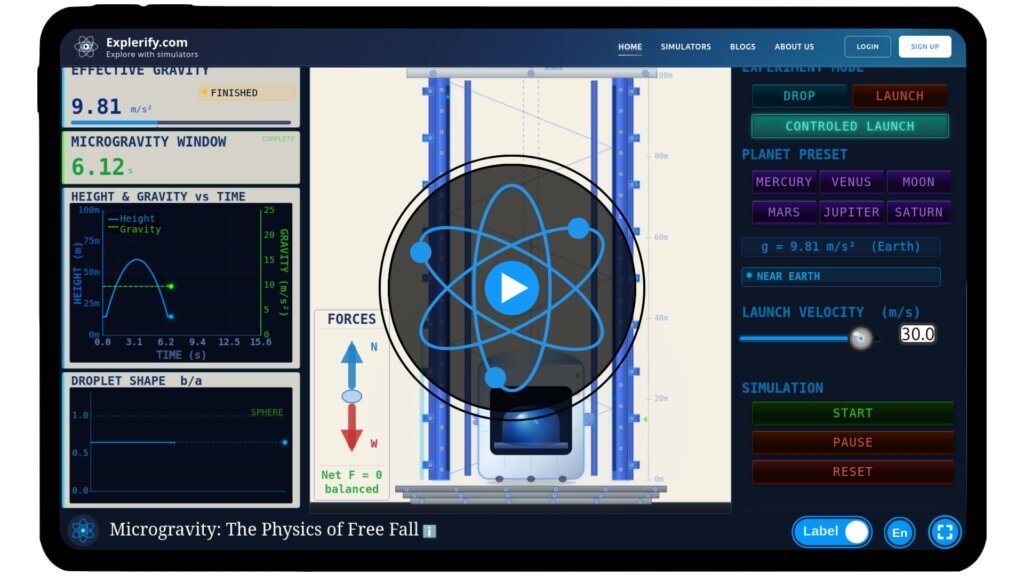
Microgravity: The Physics of Free Fall
Physics surrounds us, influencing countless aspects of our daily lives—often in ways we don’t even notice. Have you ever wondered why astronauts appear to float, as if gravity has vanished? The answer lies in the fascinating concept of microgravity, where objects in free fall experience weightlessness.
With our interactive simulator, you can recreate this effect by launching a capsule into free fall. Observe how objects inside behave, adjust conditions, and discover how gravity still acts—yet everything falls together. Uncover the science behind weightlessness and step into Einstein’s elevator thought experiment. Start your journey into the physics of microgravity—experiment with free fall today!
\( N = m(g – a) \)
Mathematical description
where:
\( N \) normal force (apparent weight)
\( m \) mass of the object
\( g \) acceleration due to gravity
\( a \) acceleration of the system (capsule)
Tutorial video
Take a quick spin through our simulator!
Explore Microgravity & Drop-Towers
One Question at a time!
Q1. What is microgravity and how is it measured?
Microgravity (symbol: μg) is a condition where the net gravitational acceleration experienced by an object is between 10⁻⁶ and 10⁻⁴ times Earth's surface gravity (g = 9.81 m/s²). The ISS, orbiting at ~400 km altitude, is humanity's primary long-duration microgravity laboratory.
Q2. Which scientific principles explain how microgravity is created?
Microgravity is created using kinematics — by artificially negating Earth's gravity using a force of almost equal magnitude in the opposite direction. Two approaches are used:
- Centrifugal force: When an object rotates, it experiences an outward push. In a rotating spacecraft or space station, this outward centrifugal force can be tuned to cancel gravity, making objects inside feel weightless.
- Pseudo-force during free fall: When an object is in free fall — like a spacecraft in orbit — it experiences a pseudo-force directed away from Earth, exactly equal and opposite to gravity. The occupants feel no net gravitational pull. This is what astronauts experience on the ISS.
Q3. What is a drop tower and how is microgravity measured inside it?
A drop tower is a tall structure — or deep shaft — used to produce controlled periods of microgravity on Earth by placing an experiment in free fall. Microgravity quality is measured as a fraction of g (9.81 m/s²). The best drop towers, like ZARM in Bremen, achieve residual accelerations as low as 10⁻⁶ g — matching the quality of the ISS — making them the most precise ground-based microgravity platforms available to researchers worldwide. Drop towers are also referred to as Einstein Elevators as they famously simulate Einstein's thought experiment regarding the equivalence principle, which states that free fall is indistinguishable from weightlessness.
Q4. Which scientific principle explains how a drop tower creates microgravity?
A drop tower exploits Newton's pseudo-force principle during free fall. When the experiment capsule is released, it and everything inside it accelerate downward at exactly g = 9.81 m/s² — the same rate. Since there is no relative acceleration between objects inside the capsule, no gravitational force is felt. Einstein's Equivalence Principle confirms this: a body in free fall cannot locally distinguish between weightlessness and the complete absence of gravity. The tower simply makes this free-fall state last long enough to run an experiment.
Q5. How is a drop tower physically set up and how does a drop work step by step?
A drop tower experiment follows these steps:
- The experiment capsule is loaded and sealed at the top of an evacuated steel tube — vacuum eliminates air drag that would otherwise create a false g-force.
- The capsule is released and free-falls through the tube, reaching 10⁻⁶ g within milliseconds.
- Onboard sensors and cameras record data autonomously — no human can intervene mid-drop.
- At the bottom, a deceleration system (polystyrene pellets or magnetic brakes) arrests the fall.
- In catapult mode (ZARM), the capsule is launched upward at 30× g before free-falling back — nearly doubling microgravity time.
Q6. How do scientists create microgravity without going to space — what platforms are used?
Three Earth-based platforms simulate microgravity:
- Drop Towers: A sealed capsule is free-fallen inside an evacuated shaft for 2–9 seconds, reaching 10⁻⁶ g. NASA Glenn's 145 m Zero Gravity Research Facility is the gold standard.
- Parabolic Aircraft: The aircraft flies steep arcs — nicknamed the 'Vomit Comet' — giving 20–25 seconds of ~10⁻² g per arc, repeated 30+ times per flight. Used for human subject experiments.
- Sounding Rockets: Follow a ballistic arc above the atmosphere, delivering 6–15 minutes of μg — long enough for biological and fluid experiments impossible in a drop tower.
Q7. Why do flames, fluids, and crystals behave so differently in microgravity?
On Earth, gravity drives buoyancy, convection, and sedimentation — three forces that dominate almost every physical process. Microgravity eliminates all three. A candle flame becomes spherical (not teardrop-shaped) because there is no convective upward flow. Fluids of different densities no longer separate. Crystals grow larger and more perfect because particles are no longer dragged downward during formation. Every familiar physical phenomenon transforms when this single constant force is removed.
Q8. What are the key scientific and industrial applications of microgravity research?
Many phenomena — buoyancy (floating of less dense objects), convection (rising of hot, light gas), and sedimentation (settling of heavy particles) — occur because of gravity. In microgravity, all three are absent. This lets scientists freely manipulate particles and molecules without worrying about their weight. Key applications include:
- Drug Development: Protein crystals grown in microgravity are far more uniform than Earth-grown ones. Merck used the ISS to grow better crystals of Keytruda® — its cancer drug — potentially converting it from a hospital IV drip to a home-injectable, making cancer treatment far more accessible.
- Materials Science — ZBLAN Fibre Optics: ZBLAN fluoride glass fibre optics made in microgravity have 100× fewer crystallisation defects than Earth-made fibre, enabling vastly more efficient infrared transmission for medical imaging and telecommunications.
- Artificial Retinas: Since 2018, automated manufacturing on the ISS has produced artificial retinas across nine launch cycles, with human trials targeted from 2027.
- Semiconductor Crystals: Grown with fewer lattice defects in μg, promising next-generation chips that Earth-based fabrication cannot currently match.
Q9. What did real microgravity experiments reveal that changed our understanding of physics?
BASS-II (Burning and Suppression of Solids II) placed solid PMMA fuel rods inside a contained flow duct in the ISS Destiny Lab, operated remotely from NASA Glenn Research Center. Results showed microgravity flames sustain combustion at oxygen concentrations as low as 17% — below the 18% threshold in normal gravity. This overturned theoretical predictions and directly redesigned spacecraft fire safety systems. Japan's KIBO module used electrostatic levitation furnaces to measure properties of molten metals with zero container contact — eliminating contamination entirely.
Q10. What is the single deepest insight microgravity gives us about the physical world?
Microgravity reveals that gravity is not just a force — it is a permanent mask over almost every physical and biological process on Earth. Remove it and familiar phenomena transform entirely: flames go spherical, fluids refuse to separate, crystals grow flawlessly, and cancer cells self-organise into 3D tumour-like structures that Earth lab dishes cannot replicate. Every experiment in μg asks: 'What does nature actually look like without gravity's constant interference?' The answers are rewriting physics, medicine, and materials science simultaneously.