Affine Cipher

Affine Cipher Simulator

Explore the classical Affine Cipher and experiment with different key values to encrypt and decrypt messages. Visualize how modular arithmetic transforms plaintext into ciphertext with our interactive simulator.
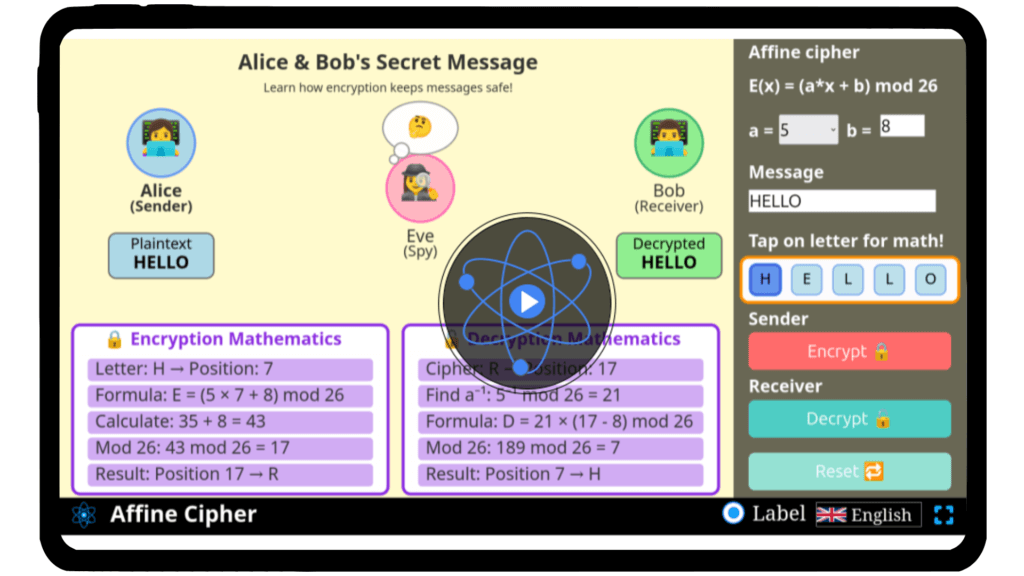
Affine Cipher

Cryptography surrounds us, securing countless aspects of our digital lives, often in ways we take for granted. Have you ever wondered how letters and numbers can be transformed into secret messages? The classical Affine Cipher achieves this using simple yet elegant modular arithmetic. With our interactive simulator, you can explore this encryption method directly. Adjust the keys, encrypt and decrypt messages, and uncover the mathematics behind secure communication. Start your journey into the fascinating world of classical cryptography — experiment with the Affine Cipher today!

Mathematical description

The Affine Cipher is a monoalphabetic substitution cipher that uses a linear transformation to encrypt plaintext letters. Each letter is first converted into a number (A = 0, B = 1, …, Z = 25). The encryption and decryption formulas are:

Encryption:
\( E(x) = (a \cdot x + b) \mod 26 \)
where:

  • \(x\) = numeric value of the plaintext letter

  • \(a\), \(b\) = keys (with \(a\) coprime to 26)

Decryption:
\( D(y) = a^{-1} \cdot (y – b) \mod 26 \)
where:

  • \(y\) = numeric value of the ciphertext letter

  • \(a^{-1}\) = modular multiplicative inverse of \(a\) modulo 26

Example:

Encrypt plaintext HELLO with keys \(a = 5\), \(b = 8\):

  1. Convert letters to numbers: H=7, E=4, L=11, L=11, O=14

  2. Apply encryption formula:

    • H → \(E(7) = (5*7 + 8) \mod 26 = 43 \mod 26 = 17\) → R

    • E → \(E(4) = (5*4 + 8) \mod 26 = 28 \mod 26 = 2\) → C

    • L → \(E(11) = (5*11 + 8) \mod 26 = 63 \mod 26 = 11\) → L

    • L → L

    • O → \(E(14) = (5*14 + 8) \mod 26 = 78 \mod 26 = 0\) → A

Ciphertext: RCLLA

To decrypt RCLLA back to HELLO, use the decryption formula with \(a^{-1} = 21\) (mod 26):

  • R → \(D(17) = 21*(17-8) \mod 26 = 21*9 \mod 26 = 7\) → H

  • C → \(D(2) = 21*(2-8) \mod 26 = 21*(-6) \mod 26 = 4\) → E

  • L → L

  • L → L

  • A → \(D(0) = 21*(0-8) \mod 26 = 21*(-8) \mod 26 = 14\) → O

Decrypted text: HELLO

Simulator

Dive into the world of classical cryptography with our interactive Affine Cipher simulator and explore how modular arithmetic transforms plaintext into secure messages!

Share with your friends
Dynamic Progress Tracker - Fixed
Loading progress...

FAQs on Newton's Rings

Qus 1. What is the principle behind the Affine Cipher?

The Affine Cipher is a type of monoalphabetic substitution cipher based on modular arithmetic. Each letter in the plaintext is mapped to its numeric equivalent, transformed using a mathematical function, and then converted back to a letter. The encryption function is:
\( E(x) = (ax + b) \mod m \)
where x is the numeric value of the plaintext letter, a and b are keys, and m is the size of the alphabet (typically 26). The decryption function is:
\( D(y) = a^{-1} (y – b) \mod m \)
where a⁻¹ is the modular inverse of a modulo m.

Qus 2. What are the applications of the Affine Cipher?

  • Educational purposes: to teach modular arithmetic and classical cryptography.

  • Puzzle and recreational cryptography.

  • Historical analysis: understanding early encryption techniques before modern ciphers.

Note: The Affine Cipher is not secure for real-world communication today due to its vulnerability to frequency analysis.

Qus 3. What is the historical significance of the Affine Cipher?

  • The Affine Cipher is a classical substitution cipher used in early cryptography.

  • It is a generalization of the Caesar Cipher, adding more flexibility through two keys instead of one.

  • It was studied extensively in the 19th century and is important for understanding the development of modern encryption concepts.

Qus 4. How do you choose keys for the Affine Cipher?

The key a must be coprime to the size of the alphabet (m), usually 26, to ensure the cipher is reversible. The key b can be any integer from 0 to m−1. If a and m are not coprime, decryption is impossible.

Qus 5. Can the Affine Cipher be broken easily?

Yes, the Affine Cipher is vulnerable to frequency analysis because it is a monoalphabetic cipher. Once an attacker analyzes letter frequencies, they can often determine the keys a and b quickly.

Qus 6. How is the Affine Cipher different from the Caesar Cipher?

While the Caesar Cipher shifts letters by a fixed amount (b), the Affine Cipher applies a linear transformation using two keys (a and b), making it slightly more complex but still vulnerable to cryptanalysis.

Qus 7. Can Affine Cipher encrypt numbers or symbols?

Traditionally, the Affine Cipher is applied to letters only. However, with a custom numeric mapping, it can be extended to numbers, punctuation, or other symbols.

Qus 8. Is the Affine Cipher used in modern encryption?

No, it is considered obsolete for real-world encryption. Its main value is educational, demonstrating concepts like modular arithmetic and linear transformations in cryptography.

Cypher - Explerify
Scroll to Top