Acousto-Optic Modulator Simulator
Explore the working principle of an acousto-optic modulator (AOM) and experiment with varying radio-frequency signals and acoustic power to observe changes in laser beam diffraction, deflection angle, and intensity using our interactive simulator.
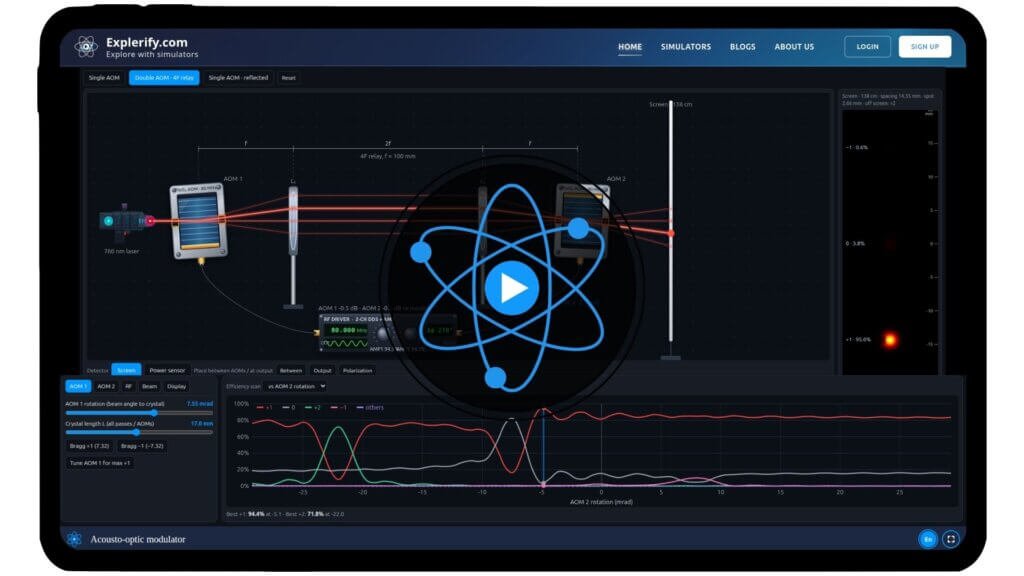
Acousto-Optic Modulator
Light plays a fundamental role in modern technology, from optical communication to precision measurements and quantum experiments. But have you ever wondered how a laser beam can be deflected, shifted in frequency, or controlled in intensity using sound waves? This fascinating phenomenon lies at the heart of an Acousto-Optic Modulator (AOM), a device that uses acoustic waves to manipulate light through diffraction. With our interactive simulator, you can explore the principles of acousto-optic interactions firsthand. Adjust the radio-frequency (RF) signal and acoustic power, observe changes in the diffraction angle and beam intensity, and discover how sound waves can precisely control light. Step into the fascinating world of acousto-optics and uncover the science behind laser beam manipulation — experiment with our Acousto-Optic Modulator Simulator today!
\( \theta_B = \frac{\lambda f_{\mathrm{RF}}}{2 n v_a} \)
Mathematical description
where:
– \( \theta_B \) is the Bragg angle
– \( \lambda \) is the wavelength of the incident light (in vacuum)
– \( f_{\mathrm{RF}} \) is the applied radio frequency
– \( n \) is the refractive index of the crystal
– \( v_a \) is the speed of sound inside the crystal
FAQs on AOM
1. What is an Acousto-Optic Modulator (AOM)?
An Acousto-Optic Modulator (AOM) is an optical device that uses sound waves to control the intensity, frequency, and direction of a laser beam. When an RF signal is applied to a piezoelectric transducer attached to a transparent crystal, it generates acoustic waves that produce periodic variations in the crystal’s refractive index. These variations act as a moving diffraction grating, allowing the incident laser beam to be diffracted into different orders.
2. How does an AOM work?
An AOM operates through the acousto-optic effect, in which acoustic waves traveling through a crystal create periodic changes in its refractive index. When a laser beam enters the crystal at an appropriate angle, it interacts with this moving refractive-index grating and undergoes diffraction. The diffraction angle depends on the acoustic frequency, while the diffraction efficiency depends on the acoustic power and interaction conditions.
3. How does changing the RF frequency affect the diffracted beam?
Changing the RF frequency changes the wavelength of the acoustic grating inside the crystal. As the RF frequency increases, the acoustic wavelength decreases, resulting in a larger diffraction angle. This principle enables precise laser beam steering by adjusting the RF frequency. For efficient diffraction, the incident angle must also remain sufficiently close to the Bragg condition.
4. What is the difference between zeroth-order and first-order diffraction?
The zeroth-order beam passes through the AOM without undergoing diffraction and retains its original optical frequency. The first-order beam is deflected by the acoustic grating and experiences a frequency shift equal to the RF frequency in magnitude. By adjusting the RF power, the relative intensities of these beams can be controlled.
5. What is the difference between Bragg diffraction and Raman–Nath diffraction?
The visibility of Newton’s Rings depends on factors like the wavelength of light, the angle of observation, and the type of surfaces involved. Variations in light wavelength or surface smoothness can impact ring clarity and contrast.
Bragg and Raman–Nath diffraction describe two different regimes of acousto-optic interaction.
Bragg diffraction: Typically occurs when light interacts with the acoustic wave over a relatively long distance. Under suitable alignment, diffraction is dominated by the zeroth and one first-order beam.
Raman–Nath diffraction: Typically occurs for a shorter interaction length or a thinner effective acoustic grating, allowing light to diffract into multiple orders.
Most AOMs used for precision laser control operate in the Bragg regime.
6. Can an AOM control both the intensity and frequency of a laser beam?
Yes. An AOM can control laser intensity by varying the RF power, which changes the fraction of optical power transferred into the diffracted beam. It can also control the optical frequency by changing the RF frequency. However, changing the RF frequency also affects the diffraction angle, so these controls are not completely independent in a typical single-pass AOM.
7. Why are AOMs widely used in atomic physics and quantum optics?
AOMs provide fast and precise control over laser beams, making them essential components in many atomic physics experiments. They are commonly used for laser intensity stabilization, frequency shifting, optical trapping, laser cooling, and atom interferometry. Their ability to rapidly switch and modulate laser beams enables precise control over light–atom interactions.