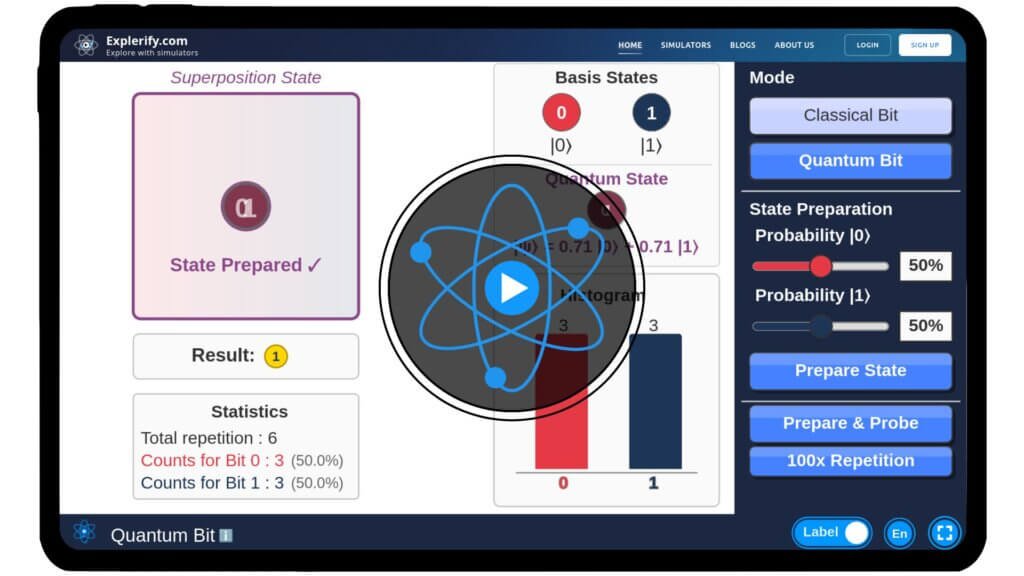
Investigate the phenomenon of quantum superposition and experiment with different measurement bases to observe probability outcomes using our interactive Quantum Coin Toss simulator.
Quantum physics governs the world at its smallest scales — a realm where certainty gives way to probability and particles can exist in multiple states at once. Have you ever wondered what happens when you flip a coin that follows the rules of quantum mechanics? In our Quantum Coin Toss Simulator, you can explore this fascinating concept firsthand. Experiment with superposition, adjust measurement bases, and observe how observation itself determines the outcome. Step into the quantum world and experience the curious nature of chance — try the Quantum Coin Toss today!
Mathematical description
\[ |\psi\rangle = \alpha |0\rangle + \beta |1\rangle, \] where \( \alpha \) and \( \beta \) are complex probability amplitudes satisfying the normalization condition
\[ |\alpha|^2 + |\beta|^2 = 1. \]
According to the Born rule, the probabilities of obtaining each outcome upon measurement in the computational basis are given by
\[ P(0) = |\alpha|^2, \quad P(1) = |\beta|^2. \]
Thus, the quantum coin can exist in a superposition of both heads \((|0\rangle)\) and tails \((|1\rangle)\) until a measurement collapses it into one of these states with the respective probabilities.
Simulator
Dive into the physics of quantum superposition with our interactive Quantum Coin Toss simulator!
Interactive Physics Simulator – Image Formation by Concave Mirror
Share with your friends
FAQs on Quantum coin toss
Qus 1. What is a quantum coin toss?
A quantum coin toss is a simple way to illustrate how quantum particles behave in a superposition of states. Unlike a classical coin that is either heads or tails, a quantum coin can exist in both states simultaneously until it is measured.
Qus 2. What principle does the quantum coin toss demonstrate?
It demonstrates the principle of superposition — a fundamental concept in quantum mechanics where a system can exist in multiple states at once. When measured, the system “collapses” into one definite state, with the outcome determined probabilistically.
Qus 3. How is a quantum coin toss different from a classical coin toss?
In a classical toss, the outcome (heads or tails) is determined by physical factors like speed and angle, even if unpredictable. In a quantum toss, the outcome is truly random, governed by the probabilities encoded in the quantum state’s amplitudes.
Qus 4.What are the applications of the quantum coin toss?
The concept is foundational in many quantum technologies, such as:
Quantum computing: superposition and measurement form the basis of qubit operation.
Quantum cryptography: randomness from quantum measurement is used for secure key generation.
Quantum random number generation: true randomness from quantum outcomes is applied in simulations, encryption, and secure communication.
Qus 5. What happens during measurement?
Measurement forces the quantum coin’s state to collapse into one of the two possible outcomes — similar to observing which side a classical coin lands on, but fundamentally probabilistic rather than deterministic.
Qus 6. Can we control the probabilities in a quantum coin toss?
Yes. By changing the parameters (e.g., the amplitudes α and β), you can modify the likelihood of each outcome. In your simulator, this could correspond to rotating the qubit on the Bloch sphere before measurement.
Qus 7. Why is the quantum coin toss important in learning quantum physics?
It’s one of the simplest ways to visualize abstract quantum principles like superposition, measurement, and probability collapse, making it easier for students to grasp the non-classical nature of quantum systems.