Electric Charges and Field Simulator
Investigate the behavior of electric charges and electric fields. Experiment with different charge values and positions to observe how field lines and interactions change in real time using our interactive simulator.
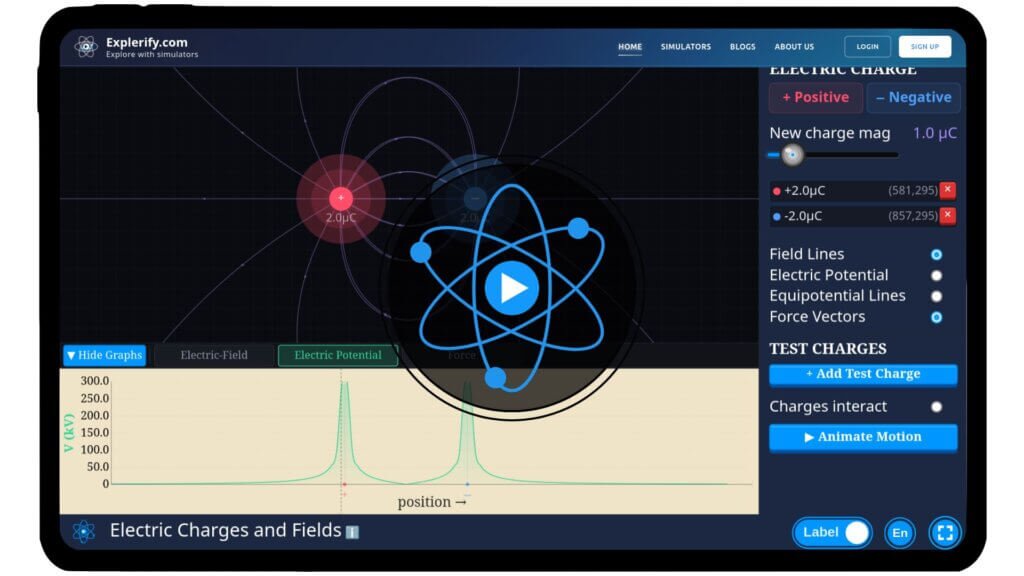
Electric Charges and Field
Physics surrounds us, shaping many aspects of our everyday lives—often in ways we don’t notice. Have you ever wondered how electric charges interact or how invisible forces act at a distance? These interactions are governed by electric fields, a fundamental concept in electrostatics. With our interactive simulator, you can explore this phenomenon firsthand. Place charges, adjust their values and positions, and watch how electric field lines respond in real time. Uncover the principles behind charge interactions and visualize the invisible forces around you. Start your journey into the world of electric charges and fields—experiment and explore today!
\( \vec{E}(\vec{r}) = \frac{1}{4\pi \varepsilon_0} \sum_{i} \frac{q_i \, (\vec{r} – \vec{r}_i)}{|\vec{r} – \vec{r}_i|^3}
\)
Mathematical description
where:
- \( \vec{E}(\vec{r}) \) is the electric field at position \( \vec{r} \).
- \( \vec{r} \) is the observation point (where the field is calculated).
- \( \vec{r}_i \) is the position of the i-th charge.
- \( q_i \) is the magnitude of the i-th charge.
- \( \varepsilon_0 \) is the permittivity of free space.
- \( \sum_i \) represents the sum over all charges.
- \( |\vec{r} – \vec{r}_i| \) is the distance between the observation point and the i-th charge.
- \( (\vec{r} – \vec{r}_i) \) gives the direction of the electric field from the charge to the point.
Explore Electric Charges & Fields
One Question at a time!
Q1. What is electric charge and what are its fundamental properties?
Electric charge is a fundamental property of matter that causes it to experience a force in the presence of other charges. It exists in two types — positive (deficiency of electrons) and negative (excess of electrons). Three properties govern all of electrostatics:
- Quantisation: charge exists only in discrete packets — integral multiples of the elementary charge e = 1.6 × 10⁻¹⁹ C. You can never have half a charge.
- Conservation: charge can neither be created nor destroyed — only transferred. The total charge in an isolated system always remains constant.
- Additivity: the total charge of a system is simply the algebraic sum of all individual charges, with sign included.
Q2. What is Coulomb's Law and what does it physically mean?
Coulomb's Law quantifies the electrostatic force between two point charges. The formula is: F = k·q₁·q₂ / r², where k = 9 × 10⁹ N m² C⁻² (Coulomb's constant), q₁ and q₂ are the charges, and r is the distance between them. The force is attractive for unlike charges and repulsive for like charges. Critically, the force follows an inverse-square law — doubling the distance reduces the force to one-quarter. Coulomb's constant k = 1/4πε₀, where ε₀ = 8.85 × 10⁻¹² C² N⁻¹ m⁻² is the permittivity of free space.
Q3. What is an electric field and how is it different from electric force?
An electric field E is a region around a charge where any other charge placed in it experiences a force. It is defined as E = F/q₀, where F is the force experienced by a small positive test charge q₀ placed at that point. The SI unit of electric field is N/C or V/m. The key distinction: force F depends on both charges involved (F = kq₁q₂/r²), while electric field E depends only on the source charge creating it (E = kq/r²). The electric field is a property of space itself — it exists whether or not a test charge is placed in it.
Q4. What are electric field lines and what rules govern them?
Electric field lines are imaginary lines drawn in space to visualise the direction and strength of an electric field. They follow strict rules:
- Field lines originate from positive charges and terminate at negative charges.
- The tangent to a field line at any point gives the direction of the electric field at that point.
- The density of field lines (lines per unit area) represents the strength of the field — closer lines mean stronger field.
- Field lines never cross each other — if they did, the electric field would have two directions at one point, which is impossible.
- Field lines are always perpendicular to the surface of a conductor at the surface.
Q5. What is an electric dipole and what is its significance in physics?
An electric dipole is a system of two equal and opposite charges (+q and −q) separated by a small distance 2a. The electric dipole moment is defined as p = q × 2a, directed from negative to positive charge. Its SI unit is C·m. Dipoles matter because most molecules — like water (H₂O) — are natural electric dipoles, with asymmetric charge distribution. A dipole placed in a uniform electric field E experiences a torque τ = pE sinθ, which tries to align the dipole along the field. This principle explains how microwave ovens cook food — water molecules rotate to align with the oscillating microwave field, generating heat through friction.
Q6. What is electric flux and what does it physically represent?
Electric flux (φ) measures the total number of electric field lines passing through a given surface. Mathematically, φ = E · A · cosθ, where E is the electric field magnitude, A is the surface area, and θ is the angle between the field and the normal to the surface. Flux is maximum when field lines pass perpendicularly through the surface (θ = 0°) and zero when field lines are parallel to the surface (θ = 90°). The SI unit of electric flux is N·m²/C or V·m. Electric flux is the conceptual bridge that links the electric field in space to the charge that creates it — as formalised in Gauss's Law.
Q7. What is Gauss's Law and why is it more powerful than Coulomb's Law?
Gauss's Law states that the total electric flux through any closed surface (called a Gaussian surface) equals the net charge enclosed divided by ε₀. Mathematically: φ = ∮E·dA = Q_enclosed / ε₀. While Coulomb's Law calculates the force between two point charges, Gauss's Law calculates the electric field for any charge distribution using symmetry — making it far more powerful for complex geometries:
- For a uniformly charged sphere: E = kQ/r² outside (behaves like a point charge).
- For an infinite line charge: E = λ/2πε₀r.
- For an infinite plane of charge: E = σ/2ε₀, independent of distance.
Gauss's Law is one of Maxwell's four equations — the entire theory of electromagnetism rests on it.
Q8. How are electric charges and fields applied in science and technology?
Electrostatics drives a remarkable range of real-world technologies:
- Electrostatic precipitators: industrial chimneys use electric fields to charge smoke particles, which are then attracted to oppositely charged plates — removing over 99% of pollutants from power plant emissions.
- Photocopiers and laser printers: a photoconductor drum is charged electrostatically; a laser selectively discharges it to form an image; toner (charged ink powder) sticks to charged areas and transfers to paper.
- Van de Graaff generators: used in nuclear physics research to accelerate particles to high energies using voltages up to 15 million volts.
- Inkjet printers: tiny ink droplets are given precise charges and deflected by electric field plates to land at exact positions on paper.
Q9. What is electrostatic shielding and why does it matter?
Electrostatic shielding is the phenomenon by which the interior of a hollow conductor is completely shielded from external electric fields. When an external field is applied, charges redistribute on the outer surface of the conductor until the field inside becomes exactly zero. This is why: inside a car during a lightning strike you are safe — the car body acts as a Faraday cage. Electronic instruments in sensitive experiments are enclosed in metal boxes to prevent external fields from interfering with measurements. The principle was first demonstrated by Michael Faraday in 1836, who built a room lined with metal foil and showed that no electric field could penetrate it — now called a Faraday cage.
Q10. What is the single deepest insight electric charges and fields give us about the physical universe?
Electric charge is one of only three fundamental properties of matter — alongside mass and spin. Every force you experience in daily life, except gravity, is ultimately electromagnetic: the hardness of a table, the strength of a chemical bond, the firing of a neuron — all are manifestations of Coulomb's law acting at the atomic scale. The electric field concept, introduced by Michael Faraday, shifted physics from action-at-a-distance (two charges somehow influencing each other across empty space) to the field view — where a charge first creates a field that fills all of space, and that field then acts on other charges. This idea of the field as a physical reality, not just a mathematical tool, became the template for every subsequent theory in physics — from magnetism to gravity to quantum fields.