Lunar Mission Simulator
Investigate the journey from Earth to the Moon and experiment with launch conditions and trajectories to observe how gravity and motion shape a lunar mission using our interactive simulator.
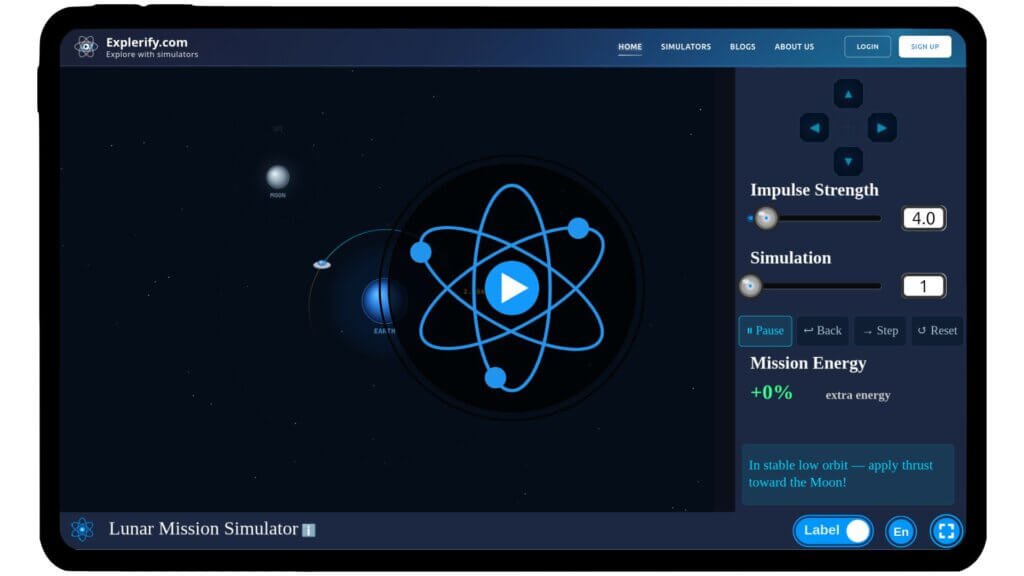
Lunar Mission
Physics surrounds us, shaping even the most ambitious human endeavors beyond Earth. Have you ever wondered how a spacecraft travels from our planet to the Moon with such precision? This remarkable journey is guided by the fundamental principles of motion and gravity. With our interactive Lunar Mission Simulator, you can explore this mission step by step. Modify launch conditions, trace orbital paths, and watch how a spacecraft navigates the Earth–Moon system. Begin your journey into the physics of space travel and discover what it takes to reach the Moon — simulate a lunar mission today!
\( \vec{F} = -G \frac{m_1 m_2}{r^2} \hat{r} \)
Mathematical description
where:
- \(\vec{F}\) is the gravitational force acting on the spacecraft.
- \(G\) is the gravitational constant (6.674 × 10^-11 m³/kg·s²).
- \(m_1\) is the mass of the spacecraft.
- \(m_2\) is the mass of the celestial body (Earth or Moon).
- \(r\) is the distance between the centers of mass of the two bodies.
- \(\hat{r}\) is the unit vector pointing from the spacecraft toward the celestial body.
FAQs on Lunar Mission
Qus 1. How can a lunar mission help humankind?
A lunar mission advances science and technology, inspires global collaboration, and may pave the way for resource utilization on the Moon, such as mining rare minerals or generating energy. It also helps us understand the Moon’s history and Earth’s formation.
Qus 2. What are the possible applications of lunar exploration?
Scientific research (geology, astronomy)
Testing space technology for Mars or deep space missions
Resource extraction (water ice, Helium-3)
Developing infrastructure for future human colonies
Qus 3. How much does a lunar mission cost?
Costs vary widely based on mission type:
Robotic missions: hundreds of millions USD
Human missions: several billion USD
Budget depends on technology, duration, and objectives.
Qus 4.What are the different stages of preparation for a lunar mission?
Mission planning and goal setting
Designing spacecraft and instruments
Simulations and testing
Astronaut training (for manned missions)
Launch, travel, landing, and return operations
Qus 5. How is the launch and landing prepared?
Launch: Rockets are designed, tested, and fueled. Trajectories are calculated to reach the Moon efficiently.
Landing: Lunar landers are tested for soft landing, navigation, and surface operations. Autonomous systems or manual control is prepared to handle challenges.
Qus 6. What is the history of lunar missions?
1959: First human-made object reaches the Moon (Luna 2, USSR)
1969: First humans land on the Moon (Apollo 11, USA)
1970s–2000s: Robotic orbiters and landers explore the Moon
2000s–present: Renewed interest in lunar bases, resource exploration, and international collaboration
Qus 7. How can one become an astronaut?
Astronauts typically need a strong background in science, engineering, or medicine, excellent physical health, and experience in high-stress, technical environments. Rigorous training in zero-gravity simulations, spacecraft systems, and survival skills is essential.
Qus 8. How do humans generate energy on the Moon?
Energy can be generated using solar panels, nuclear reactors, or fuel cells. Solar power is the most practical, as sunlight is abundant on the lunar surface for long periods, especially near the poles.
Qus 9. How will the supply of oxygen be maintained?
Oxygen can be supplied from stored tanks, generated onboard spacecraft, or extracted from lunar resources like water ice (through electrolysis). Recycling systems are also critical for long-term missions.
Qus 10. What if we find water on the Moon? What are the next steps?
Water can be used for drinking, oxygen production, and fuel (hydrogen and oxygen for rockets). Finding water could support long-term lunar bases, refueling stations, and deeper space missions.
Qus 11. How is the Moon different from Mars?
The Moon is closer (3 days vs. 6–9 months to Mars)
It has lower gravity (1/6th of Earth) compared to Mars (1/3rd)
No significant atmosphere, making protection from radiation crucial
Mars has water in ice and possibly soil, a thin atmosphere, and potential for long-term colonization, while the Moon is mainly useful for refueling, research, and short-term missions