Force on a current carrying wire in magnetic field
A current carrying wire in a magnetic field experiences a magnetic force. With our simulator, we wish to provide you a visualization of the magnetic force on the current carrying wire. Experiment with the controls, change variables, and see how they affect the magnetic force on the current carrying wire. Clarify your doubts and deepen your understanding. Dive in and start simulating now!
\(F = ILB \sin(\theta)\)
Mathematical description
where:
\( I \) is the current carried in the wire
\( L \) is the length of the wire
\( B \) is the strength of the magnetic field
\(\theta \) is the angle between the magnetic field vector and length vector
Simulator
Discover the physics of electromagnetic forces with our interactive magnetic force on a current-carrying wire simulator!
Interactive Physics Simulator – Image Formation by Concave Mirror
Share with your friends
Compact User Progress Tracker
🌟 You May Also Like
Suggested experiments and activities based on your progress...
FAQs on Magnetic Force on a Current carrying wire
Qus 1. What is the magnetic force on a current-carrying wire?
The magnetic force on a current-carrying wire arises when the wire is placed in a magnetic field. The force results from the interaction between the magnetic field and the moving charges within the wire.
Qus 2. Why does a current-carrying wire in a magnetic field experience a force?
A current-carrying wire experiences a force in a magnetic field because the moving charges (electrons) within the wire interact with the magnetic field, resulting in a force perpendicular to both the direction of current and the magnetic field. Each moving electron experiences the Lorentz force. The force experienced by the current carrying wire is the the combination of Lorentz force experienced by all the moving electrons within the wire.
Qus 3. How do you determine the direction of the magnetic force on a wire?
You determine the direction of the magnetic force using the right-hand rule. Point your thumb in the direction of the current, your fingers in the direction of the magnetic field, and the force on the wire will be in the direction your palm faces.
Qus 4. What is the formula for calculating the magnetic force on a current-carrying wire?
The current carrying wire in a magnetic field experiences a magnetic force F
\(\mathbf{F} = I \mathbf{L} \times \mathbf{B}\)
\(F = ILB \sin(\theta)\)
Where I is the current carried in the wire, Lis the length of the wire and B is the strength of the magnetic field and \(\theta \) is the angle between the magnetic field vector and length vector.
Qus 5. What factors affect the magnitude of the magnetic force?
The magnetic force on a current carrying wire depends upon the following factors:
Length: The longer the current-carrying wire, the greater is the amount of electrons flowing through it, resulting in the stronger consolidated magnetic force exerted on the wire.
Current: The higher the current in the wire, the faster the electrons flow (more speed), the higher the resultant Lorentz force acting on all the electrons flowing within the wire.
Angle: The magnetic force is dependent upon the cross product of magnetic field vector and length vector. The force is maximum when wire is perpendicular to the magnetic field (\(\theta = 90^\circ\)) and zero when wire is parallel to the magnetic field (\(\theta = 0^\circ\))
Magnetic field Strength: the magnetic force is directly proportional to the field strength.
Thanks for your message! We really appreciate you taking the time to visit Explerify. Let us know if you have any questions or suggestions—we’d be happy to help.
My students and I have noticed that your simulation does not work when testing how current affects the force nor when testing for length of the wire. You get a horizontal line and constant magnetic force for each instead of the expected linear positive correlation.
Thank you for your feedback and for testing the simulator with your students.
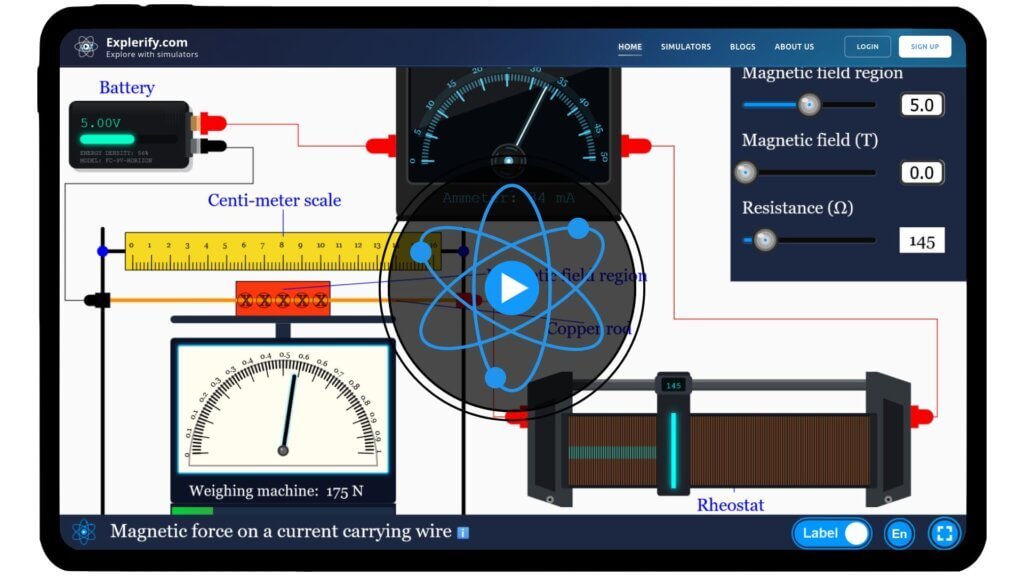
The purpose of this simulator is to demonstrate the force interaction between a current-carrying wire and an external magnetic field source placed on a weighing scale. When current passes through the wire, the wire experiences a magnetic force due to the external magnetic field. Due to the magnetic force the reading on the weighing scale changes.
The magnetic field shown by the crosses in the simulator represents a constant external magnetic field, not the magnetic field produced by the current-carrying wire itself.
When the resistance of the wire is changed, the current through the wire changes, which in turn changes the magnetic force. This effect can be observed through the weighing scale reading.
The wire length itself cannot be changed in the simulator. However, the effective length of the wire within the magnetic field region can be adjusted by changing the field region relative to the wire, and the effect of this change can also be observed on the weighing scale.
This simulator is designed as a thought experiment to make the concept of force on a current-carrying wire more intuitive and easier to visualize.
Thank you again for your observations and suggestions.
First, I understand the purpose and mechanics of this simulation. We run this lab in class. The basic procedure is to find the weight of the magnet without current in the wire and then turn on the current and remeasure the “weight” on the scale. Taking the difference in the two weights provides a value for the magnetic force between the wire and magnet. Then allowing you to test the relationships between F vs I, F vs B, and F vs length of wire.
I was intending to use your very detailed sim to replicate this lab for absent students. But without being able to turn off the current (I suggest maybe adding a switch between the battery and Ammeter) I had instructed students to turn the magnetic field down to zero with the slider to get the gravitational weight of the magnet only. It was in this setting that I first noticed the issue. With the magnetic field turned down to zero changing the current still affects the weight reading, but there shouldn’t be any interaction in this setting since the magnet is essentially turned off. This made it an issue when students were trying to get a baseline reading for the weight of the magnet and when students adapted to find separate baselines for each of the currents they were testing they ended up with a constant magnetic force (horizontal line graph) suggesting no relationship between the current and the force.
The second issue was discovered by another one of my students when they were testing length (“magnetic field region”). Again starting with the magnetic field turned down to zero I had noticed the weight changing when the “Magnetic field region” was changed. I assumed this had to do with the weight of the magnet. So students were instructed to start by getting different baseline weights for each of the magnets with the “Magnetic Field T” once again turned down to zero. However when turning the magnetic field back on to a controlled value they once again get a constant force for each magnetic field region. This data again suggests no relationship between wire length and force.
I really like your simulation setup and would like to use it in my class in the future which is why I am reaching out to you. If you have further questions or would like to continue this conversation by email that would be fine too. Thanks for your time.
Hi Marcus, Thanks for taking out time and explaining the issue in detail. You are totally correct in pointing out the problems.
We have refined the simulator and ironed out the issues. The simulator is good to go for classroom exploration.
Hope you and your students have a great learning experience.
One more question. Does the weighing machine give the value of the combined weight magnet (force of earth on magnet) and the force of wire on the magnet as a typical scale would during this experiment? Or, is it your intention that it is just displaying the force of the wire on the magnet?
I assume its the first in which case (with no way turn off the current) I could ask my students to graph the apparent weight vs each variable in order to see general trends, but they would have no way of calculating the exact force of wire on magnet. Honestly that’s just fine with me. Like I said before I really like your sim and as it is now I can still use it effectively. I just wanted to be sure. So whether you can update that or not, thank you for the clarification and your stellar responsiveness.
Hey Marcus, our sim is little different from the traditional experiment.
1. In the traditional experiment, a wire is fixed between a magnet poles and we run current through it. As the wire is fixed an equal and opposite force acts on the magnet. we measure the weight of magnet before and after switching on the current to trace the magnetic force felt.
2. In our experiment, we have taken the liberty to not fix the wire- as the wire experiences a magnetic force it weight changes.
So when there’s no current -we show the weight of the wire and when there’s current- it is the wire’s actual weight + additional magnetic force.
Hope this clears all your doubt.
blo
My brother suggested I might like this website. He was totally right.
This post truly made my day. You can not imagine just how much time
I had spent for this info! Thanks!



thx
Thanks for your message! We really appreciate you taking the time to visit Explerify. Let us know if you have any questions or suggestions—we’d be happy to help.
My brother suggested I might like this website.
He was once totally right. This post truly made my day.
You can not believe just how so much time I had spent for this info!
Thanks!
Hi,
My students and I have noticed that your simulation does not work when testing how current affects the force nor when testing for length of the wire. You get a horizontal line and constant magnetic force for each instead of the expected linear positive correlation.
Dear Marcus,
Thank you for your feedback and for testing the simulator with your students.
The purpose of this simulator is to demonstrate the force interaction between a current-carrying wire and an external magnetic field source placed on a weighing scale. When current passes through the wire, the wire experiences a magnetic force due to the external magnetic field. Due to the magnetic force the reading on the weighing scale changes.
The magnetic field shown by the crosses in the simulator represents a constant external magnetic field, not the magnetic field produced by the current-carrying wire itself.
When the resistance of the wire is changed, the current through the wire changes, which in turn changes the magnetic force. This effect can be observed through the weighing scale reading.
The wire length itself cannot be changed in the simulator. However, the effective length of the wire within the magnetic field region can be adjusted by changing the field region relative to the wire, and the effect of this change can also be observed on the weighing scale.
This simulator is designed as a thought experiment to make the concept of force on a current-carrying wire more intuitive and easier to visualize.
Thank you again for your observations and suggestions.
Thank you for your response,
First, I understand the purpose and mechanics of this simulation. We run this lab in class. The basic procedure is to find the weight of the magnet without current in the wire and then turn on the current and remeasure the “weight” on the scale. Taking the difference in the two weights provides a value for the magnetic force between the wire and magnet. Then allowing you to test the relationships between F vs I, F vs B, and F vs length of wire.
I was intending to use your very detailed sim to replicate this lab for absent students. But without being able to turn off the current (I suggest maybe adding a switch between the battery and Ammeter) I had instructed students to turn the magnetic field down to zero with the slider to get the gravitational weight of the magnet only. It was in this setting that I first noticed the issue. With the magnetic field turned down to zero changing the current still affects the weight reading, but there shouldn’t be any interaction in this setting since the magnet is essentially turned off. This made it an issue when students were trying to get a baseline reading for the weight of the magnet and when students adapted to find separate baselines for each of the currents they were testing they ended up with a constant magnetic force (horizontal line graph) suggesting no relationship between the current and the force.
The second issue was discovered by another one of my students when they were testing length (“magnetic field region”). Again starting with the magnetic field turned down to zero I had noticed the weight changing when the “Magnetic field region” was changed. I assumed this had to do with the weight of the magnet. So students were instructed to start by getting different baseline weights for each of the magnets with the “Magnetic Field T” once again turned down to zero. However when turning the magnetic field back on to a controlled value they once again get a constant force for each magnetic field region. This data again suggests no relationship between wire length and force.
I really like your simulation setup and would like to use it in my class in the future which is why I am reaching out to you. If you have further questions or would like to continue this conversation by email that would be fine too. Thanks for your time.
Hi Marcus, Thanks for taking out time and explaining the issue in detail. You are totally correct in pointing out the problems.
We have refined the simulator and ironed out the issues. The simulator is good to go for classroom exploration.
Hope you and your students have a great learning experience.
That’s great, thank you for your speedy solution.
One more question. Does the weighing machine give the value of the combined weight magnet (force of earth on magnet) and the force of wire on the magnet as a typical scale would during this experiment? Or, is it your intention that it is just displaying the force of the wire on the magnet?
I assume its the first in which case (with no way turn off the current) I could ask my students to graph the apparent weight vs each variable in order to see general trends, but they would have no way of calculating the exact force of wire on magnet. Honestly that’s just fine with me. Like I said before I really like your sim and as it is now I can still use it effectively. I just wanted to be sure. So whether you can update that or not, thank you for the clarification and your stellar responsiveness.
Warm Regards
Hey Marcus, our sim is little different from the traditional experiment.
1. In the traditional experiment, a wire is fixed between a magnet poles and we run current through it. As the wire is fixed an equal and opposite force acts on the magnet. we measure the weight of magnet before and after switching on the current to trace the magnetic force felt.
2. In our experiment, we have taken the liberty to not fix the wire- as the wire experiences a magnetic force it weight changes.
So when there’s no current -we show the weight of the wire and when there’s current- it is the wire’s actual weight + additional magnetic force.
Hope this clears all your doubt.
My brother suggested I might like this website. He was totally right.
This post truly made my day. You can not imagine just how much time
I had spent for this info! Thanks!