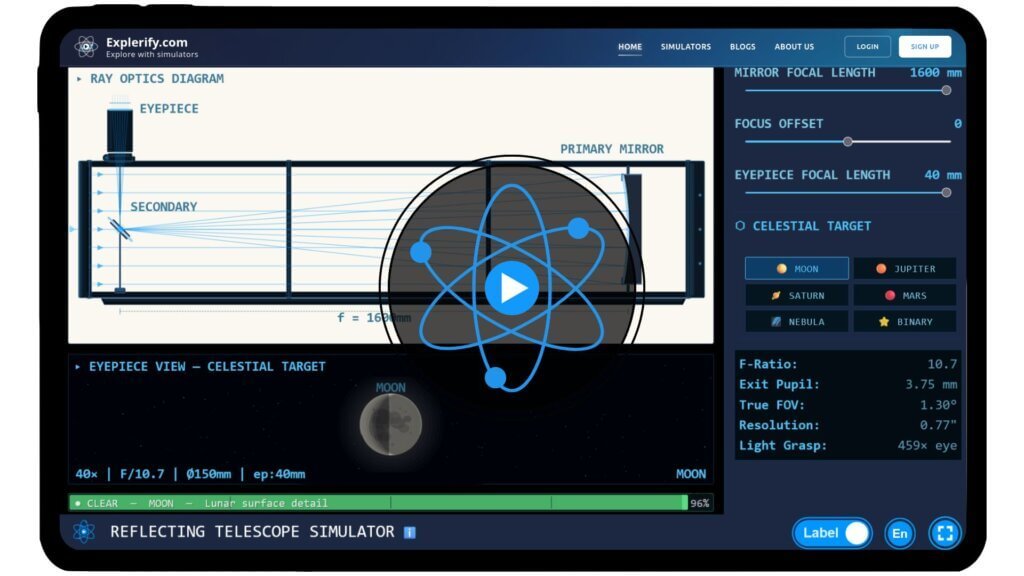
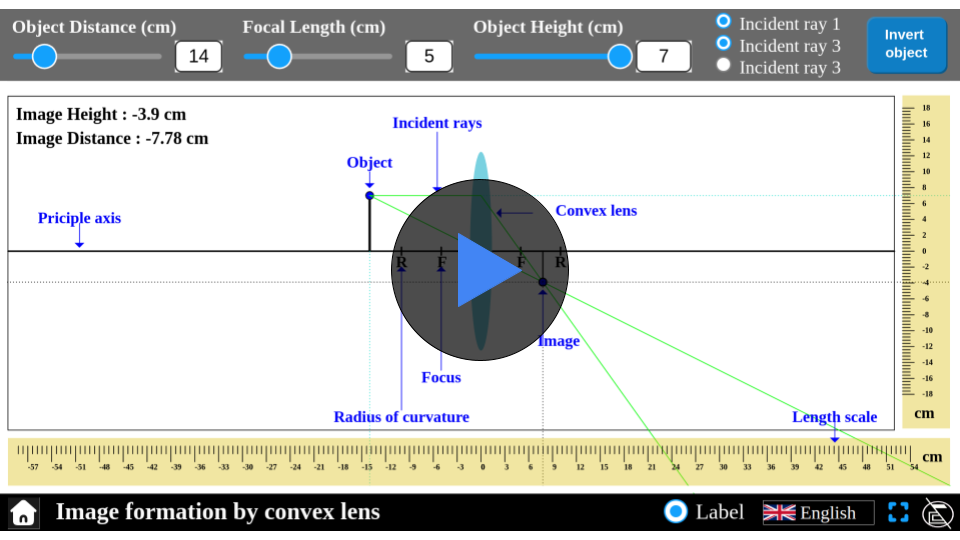
Explore how concave mirrors gather and focus light to form clear images of distant objects. Adjust mirror curvature and alignment to see how image clarity and magnification change in real time.
Physics lets us see the universe in ways that would otherwise be impossible. Have you ever wondered how astronomers capture the light of distant stars and galaxies? Mirror telescopes use precisely shaped concave mirrors to collect and focus light, forming sharp images of faraway objects. With our interactive simulator, you can explore how changing mirror curvature and alignment affects image clarity and magnification. Step into the world of optics and astronomy — experiment with a mirror telescope today!
\( M = \frac{f_{\text{objective}}}{f_{\text{eyepiece}}} \)
Mathematical description
where:
\( M \) is the Magnification of telescope,
\( f_{\text{objective}} \) is the focal length of the primary mirror,
\( f_{\text{eyepiece}} \) is the focal length of the eyepiece.
Simulator
Dive into the physics of light collection and focusing with our interactive mirror telescope simulator!
Interactive Physics Simulator – Image Formation by Concave Mirror
Share with your friends
Explore Mirror Telescope
One Question at a time!
1. What is a mirror telescope and how does it work?
A mirror telescope, also called a reflecting telescope, uses a concave mirror to gather and focus light from distant objects. Light reflects off the mirror and converges at the focal point, forming a clear image that can be viewed through an eyepiece or camera.
2. What are the applications of mirror telescopes in modern physics?
A mirror telescope, also called a reflecting telescope, uses a concave mirror to gather and focus light from distant objects. Light reflects off the mirror and converges at the focal point, forming a clear image that can be viewed through an eyepiece or camera.
3. What are some recent breakthroughs using mirror telescopes?
Recent breakthroughs include capturing the first-ever image of a black hole, mapping distant galaxies in unprecedented detail, and aiding the discovery of new exoplanets. Large telescopes like the James Webb Space Telescope rely on advanced mirror technology.
4. What careers or experts work with mirror telescopes?
Experts include astronomers, optical engineers, astrophysicists, telescope designers, and observatory technicians. Careers range from research and instrumentation to data analysis and space exploration missions.
5. What is the historical significance of mirror telescopes in wartime?
Historically, mirror telescopes improved naval navigation, military reconnaissance, and artillery accuracy. They allowed more precise observations of distant objects, giving strategic advantages in exploration and defense.
6. How have mirror telescopes helped civilization grow?
Mirror telescopes have expanded our understanding of the universe, improved navigation and timekeeping, inspired space exploration, and led to advancements in optical technologies used in cameras, microscopes, and everyday devices.
7. What is the difference between refracting and reflecting telescopes?
Refracting telescopes use lenses to bend light, while reflecting telescopes use mirrors to reflect it. Mirrors are easier to build in large sizes, don’t suffer from chromatic aberration, and are more durable, making them ideal for modern astronomy.
8. How do mirror telescopes influence everyday technology?
The optical principles used in mirror telescopes are applied in cameras, microscopes, laser systems, and even fiber optics. Understanding mirrors and light reflection has practical applications beyond astronomy.