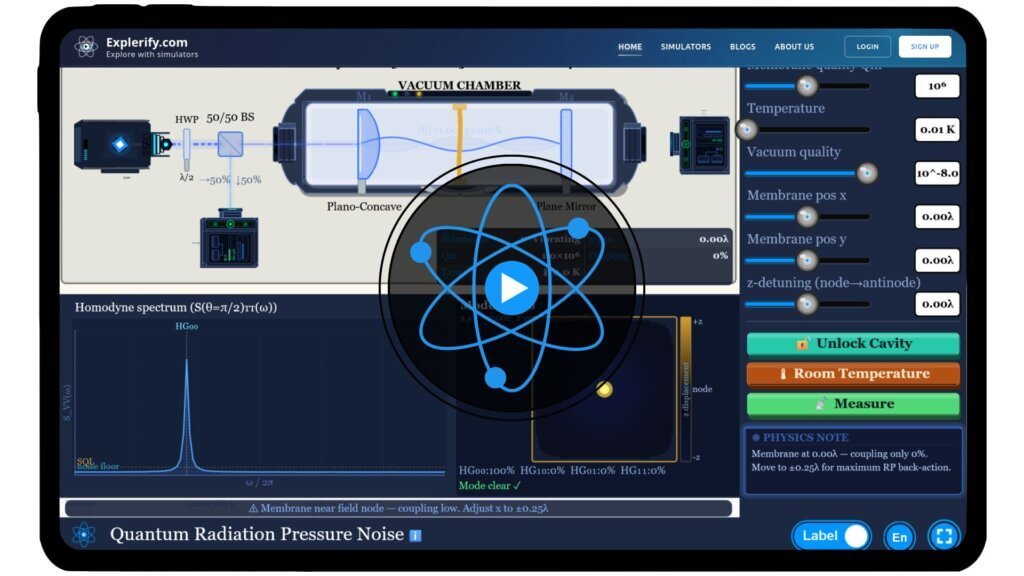
Explore quantum radiation pressure noise and experiment with photon fluctuations and system dynamics to see how light-induced forces affect precision measurements in our interactive simulator.
Physics operates even at scales far beyond our senses, shaping the limits of the most precise measurements we can make. Have you ever wondered how light—seemingly weightless—can actually push objects? At the quantum level, photons carry momentum, and their tiny, random impacts create subtle fluctuations known as quantum radiation pressure noise. These effects play a crucial role in ultra-sensitive experiments, from interferometers to modern precision measurement systems.
With our interactive simulator, you can explore this phenomenon firsthand. Adjust parameters like light intensity and system properties, observe how fluctuations arise, and understand how photon-induced forces influence motion and measurement sensitivity. Step into the world where light doesn’t just illuminate—it moves, fluctuates, and sets fundamental limits. Experiment with quantum radiation pressure noise today!
\( F = \frac{2P}{c} \)
Mathematical description
Radiation Pressure Force: Light exerts force on a mirror due to photon momentum. where:
\( P \) is the optical power
\( c \) is the speed of light
\( F \) is the radiation pressure force
Simulator
Dive into the physics of quantum radiation pressure noise with our interactive simulator!
Interactive Physics Simulator – Image Formation by Concave Mirror
Share with your friends
FAQs
1. What is quantum radiation pressure noise?
Quantum radiation pressure noise arises from tiny fluctuations in the force exerted by photons when they strike a surface. Because light is made of discrete particles (photons), the force they apply is not perfectly smooth but fluctuates randomly.
2. How can light exert force on objects?
Although light has no mass, photons carry momentum. When they hit or reflect off a surface, they transfer this momentum, producing a small force called radiation pressure.
3. Why is this effect called “quantum”?
The noise comes from the quantum nature of light—photons arrive randomly, leading to unavoidable fluctuations in force, even under steady illumination.
4. How does radiation pressure noise affect measurements?
It causes tiny, random movements in mirrors or test masses, which limits the precision of sensitive instruments like interferometers.
5. How important is this in gravitational wave detection?
In detectors like LIGO, radiation pressure noise is one of the key limiting factors at low frequencies. It competes with other noise sources and must be carefully managed to detect extremely weak signals from distant cosmic events.
6. Can increasing laser power reduce noise?
Not entirely. Increasing laser power reduces some types of noise (like shot noise) but increases radiation pressure noise. This creates a trade-off known as the standard quantum limit (SQL).
7. What is the standard quantum limit (SQL)?
It is a fundamental sensitivity limit that arises due to the balance between measurement noise (shot noise) and back-action noise (radiation pressure noise).
8. Where is this phenomenon used outside fundamental physics?
Radiation pressure effects are relevant in:
High-precision optical sensors
Nanotechnology and micro-mechanical systems
Optical trapping and manipulation (e.g., optical tweezers)
Advanced metrology systems
9. What are the real-world applications of this research?
Understanding and controlling quantum noise helps improve:
Precision measurement technologies
Quantum sensing devices
Navigation systems
Future quantum computing and communication systems
10. Can radiation pressure actually move objects?
Yes! While the force is extremely small, it can move tiny mirrors or microscopic particles, especially in controlled experimental setups.