Reflection Simulator
Explore how different mirrors transform real-world images using your camera in this interactive reflection simulator.
Reflection
Physics surrounds us, shaping the way we see and interact with the world every day. Have you ever wondered why your image appears different in a spoon, a car mirror, or a curved mirror at an amusement park? These fascinating effects are caused by the principles of reflection and image formation. With our interactive Reflection Simulator, you can use your device camera to explore how plane, concave, and convex mirrors transform real-world images in real time. Observe how images change in size, orientation, and position as you experiment with different mirrors and setups. Step into the captivating world of mirrors and optics — discover the science of reflection today!
$$ \frac{1}{f} = \frac{1}{v} + \frac{1}{u} $$
Mathematical description
Mirror formula relates the object distance, image distance, and focal length of a mirror.
where:
- \( f \) is the focal length of the mirror
- \( u \) is the object distance
- \( v \) is the image distance
Explore Reflection
One Question at a time!
Qus 1. What is reflection of light and why does it happen?
Reflection of light occurs when light rays strike a surface and bounce back into the same medium. The way light reflects depends on the surface’s shape, smoothness, and material properties. Reflection is the reason we can see mirrors, shiny objects, and even most everyday surfaces.
Qus 2. What are the different types of reflection?
The main types are specular reflection (from smooth surfaces like mirrors), diffuse reflection (from rough surfaces like walls), and specialized reflections from curved surfaces. Each type changes how light rays spread and how images appear to an observer.
Qus 3. How does the curvature of a mirror affect reflection?
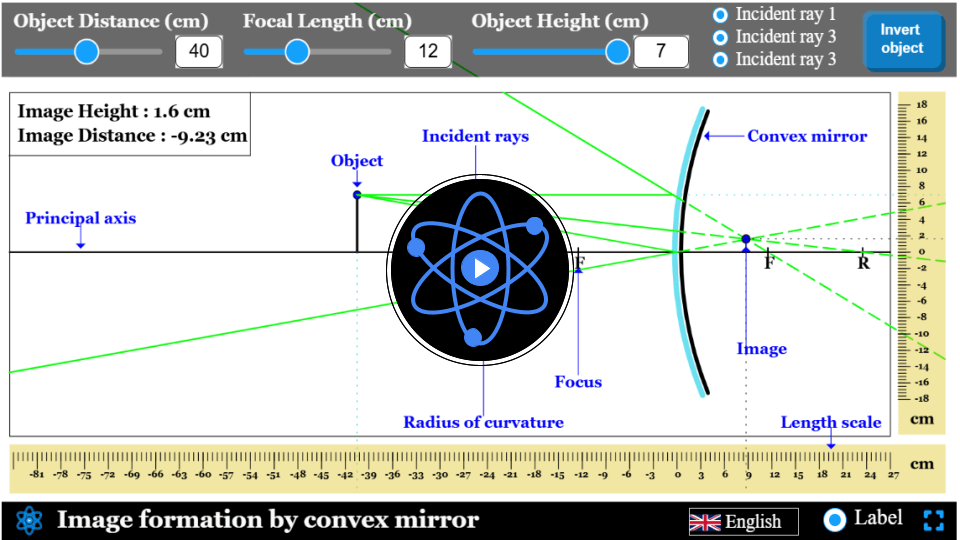
Curvature determines whether reflected rays converge, diverge, or remain parallel. A concave mirror can focus light to a point, while a convex mirror spreads light outward. The greater the curvature, the stronger the effect on image size and shape.
Qus 4. What is the difference between concave and convex mirrors?
A concave mirror curves inward and can produce magnified, real, or virtual images depending on object position. A convex mirror curves outward and always forms a smaller, upright virtual image. These properties make them useful for very different applications.
Qus 5. What is a cylindrical mirror and how does it reflect light?
A cylindrical mirror is curved in only one direction instead of all directions. It stretches or compresses images along a single axis, creating unique visual distortions. Cylindrical mirrors are often used in optical experiments, security systems, and artistic installations.
Qus 6. How do funhouse mirrors create distorted reflections?
Funhouse mirrors use varying curvatures across their surface rather than a single uniform shape. Different parts of the mirror magnify, shrink, or stretch reflected light differently. This creates the amusing tall, short, or warped images commonly seen in amusement parks.
Qus 7. How does a kaleidoscope use reflection to create patterns?
A kaleidoscope contains multiple mirrors arranged at specific angles inside a tube. Light reflects repeatedly between these mirrors, producing symmetrical patterns from a small set of colored objects. The repeated reflections create intricate designs that change as the tube rotates.
Qus 8. What is focal length and why is it important in curved mirrors?
Focal length is the distance between a curved mirror and its focal point, where parallel rays converge or appear to diverge from. It determines image size, brightness, and magnification. Mirrors with shorter focal lengths generally produce stronger optical effects.
Qus 9. Why do some mirrors produce real images while others produce virtual images?
A real image forms when reflected rays actually meet at a point and can be projected onto a screen. A virtual image forms when rays only appear to come from a point behind the mirror. Mirror shape and object position determine which type of image is produced.
Qus 10. What are the real-world applications of different reflective surfaces?
Reflection is used in vehicle mirrors, telescopes, solar concentrators, cameras, security systems, medical instruments, funhouse attractions, and kaleidoscopes. Different mirror curvatures are chosen to magnify, focus, widen, or creatively distort images depending on the application.